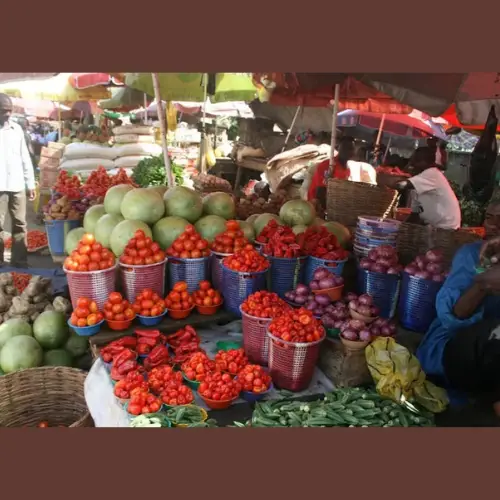
Nigeria’s latest inflation update, captured in the Nigeria CPI October 2025 report released by the National Bureau of Statistics (NBS), shows a slight but meaningful shift in the country’s price movement. While food costs are still rising, the pace of increase has slowed, offering a small dose of relief to consumers who have been dealing with months of heavy price pressure.
According to the Nigeria CPI October 2025 findings, food inflation on a month-on-month basis stood at –0.37% in October. Prices continued to climb, but at a slower speed compared to September’s –1.57%. The difference of 1.21 percentage points signals that although items like onions, fruits, shrimp, and meat still became more expensive, they did not surge as sharply as they did in the previous month.
Headline inflation also moved in a more encouraging direction. The report shows that overall inflation eased to 16.05% in October, marking a decline of 1.97 percentage points compared to the 18.02% recorded in September. Though inflation remains high, the drop suggests that some of the earlier pressures driven by supply gaps and market disruptions may be starting to lose steam.
Core inflation, which excludes food and energy, came in at 18.69% year-on-year. This represents a decline compared to the same period last year, offering another indication that deeper inflationary pressures could be slowly cooling off.
Across the states, food inflation showed wide variations. Ogun recorded the highest food inflation rate at 20.85%, followed closely by Nasarawa at 19.96% and Ekiti at 19.7%. Meanwhile, Akwa Ibom posted the lowest rate at 3.98%, with Katsina at 4.15% and Yobe at 4.29%. These state-by-state differences highlight how transportation costs, access to markets, and local supply chains continue to shape price movements.
Though food prices are still rising, the slower pace offers a small breather for households and businesses keeping a close eye on inflation trends.
For more stories like this visit naijabeats.com